Hospice Care vs. Palliative Care: What’s the Difference?
Both focus on comfort and quality of life, but they are not the same. Understanding where they overlap—and when each becomes useful—can make a difficult time much easier to navigate.

When someone is living with a serious illness, the language itself can become confusing. Palliative care, hospice, comfort care, and end-of-life care are often used as if they mean the same thing. They do not.
The distinction matters because a patient may benefit from palliative care long before hospice is appropriate—and because entering hospice does not mean that every other trusted medical relationship has to disappear.
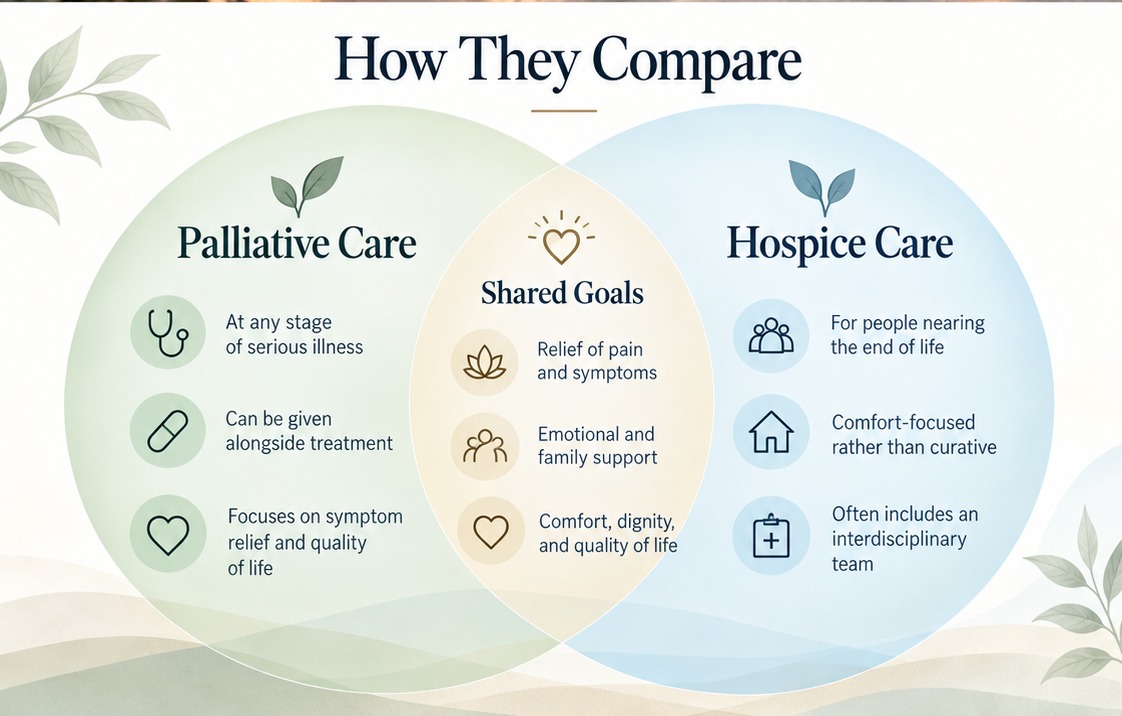
The broader approach
Focuses on relief of symptoms, stress, and suffering during serious illness. It can begin early and may be provided alongside disease-directed treatment.
A specific end-of-life benefit
Designed for people nearing the end of life, generally when the expected prognosis is about six months or less and comfort has become the primary goal.
Palliative care can begin much earlier
A person does not have to be dying to benefit from palliative care. Someone receiving cancer treatment may need help with pain, nausea, insomnia, anxiety, or fatigue. A person with advanced heart, lung, neurologic, or other chronic disease may need help sorting through increasingly complicated medical decisions.
Palliative care can exist alongside chemotherapy, surgery, medications, rehabilitation, and other disease-directed treatments. The goal does not have to be choosing between treatment and comfort. Often, the goal is to have both.
Hospice brings an entire support system
Hospice becomes appropriate when an illness has progressed to the point that care is primarily focused on comfort rather than trying to cure the terminal condition.
Hospice is much more than having a nurse visit the home. Depending on the program and the patient's needs, the hospice team can include nurses, physicians, aides, social workers, chaplains, medications related to the terminal illness, medical equipment, caregiver support, and bereavement services.
For the patient
Hospice can provide symptom management, medications and equipment related to the terminal illness, nursing support, and help responding when the patient's condition changes.
For the family
It can also provide practical guidance, caregiver support, social work, spiritual care, and help families know what to expect as illness progresses.
How Santa Fe Mobile MD fits in
Santa Fe Mobile MD is not a hospice agency. We work alongside hospice—not instead of it.
Our physicians can remain involved when a patient already has a hospice team, oncologist, primary-care physician, specialist, or other clinicians. Our role is to provide another layer of physician-level medical guidance: helping the patient and family understand what is happening, what options remain, and how to make decisions that reflect the patient's own goals.
When hospice is appropriate, it is our recommendation and preference that patients enroll. We work with hospice organizations throughout the Santa Fe area because hospice can provide the day-to-day nursing support, medications, equipment, caregiver assistance, and practical help that our physician practice is not designed to replace.
What we can add to the care already in place
End-of-life care rarely fits neatly into one box. Depending on the patient's needs and wishes, our involvement may include:
Medical guidance
Helping patients and families understand diagnoses, prognosis, treatment choices, test results, and what may happen next.
Goals-of-care conversations
Taking the time to discuss what the patient actually wants from medical care and what tradeoffs are acceptable.
Symptom management
Working with the existing care team around difficult symptoms and other medical issues as illness progresses.
Navigating the system
Helping families make sense of recommendations from hospitals, specialists, hospice teams, and other clinicians.
In-home IV ketamine
For carefully selected patients, physician-supervised treatment for severe end-of-life anxiety and certain difficult pain syndromes. Learn more →
Harmony and Healing
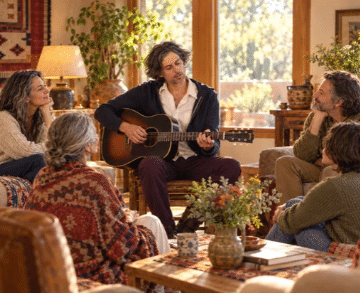
Private in-home acoustic music and legacy songwriting with our Artist in Residence, David Berkeley. Learn more →
VSED guidance
Some patients want to understand voluntarily stopping eating and drinking. We can discuss what this means medically and how it fits into broader end-of-life planning.
Medical Aid in Dying
For patients who may qualify under New Mexico law, we provide evaluation and care related to medical aid in dying. MAID services →
Hospice + Santa Fe Mobile MD + an oncologist or specialist + an existing primary-care physician can all remain part of the patient's care. The better question is not “Which doctor do I have to give up?” It is “Who should be part of the team that helps me through this?”
When should a family start these conversations?
You do not need to wait until someone is actively dying. It may be worth beginning the conversation when any of these start to feel familiar:
You do not need a hospice referral or a six-month prognosis simply to have a goals-of-care conversation with Santa Fe Mobile MD.
What if the family disagrees?
Serious illness often exposes differences within families. One person may want every possible treatment. Another may believe the patient has had enough. Someone else may simply be frightened of making the wrong decision.
Our role is not to decide for the family. It is to slow the conversation down, explain the medical realities as clearly as possible, and bring the focus back to the patient's values, priorities, and wishes.
Common questions
Can we use Santa Fe Mobile MD if we already have hospice?
Yes. In fact, when hospice is appropriate, we generally prefer to work alongside the hospice team rather than duplicate or replace the support hospice provides.
Can I keep seeing my oncologist or primary-care doctor?
Yes. Our involvement does not require you to end medical relationships that remain useful to you.
Do I need a terminal diagnosis to talk with you?
No. Palliative and goals-of-care conversations can be useful much earlier in a serious illness.
Can you help us find a hospice?
Yes. We work with hospice organizations in the Santa Fe area and can help families connect with an appropriate program when hospice becomes useful.
What is VSED?
VSED stands for voluntarily stopping eating and drinking. It is an option some patients consider near the end of life. We can discuss what it involves medically as part of a broader conversation about the patient's goals and wishes.
What does this type of consultation cost?
House calls and phone/video consultations are billed according to Santa Fe Mobile MD's usual direct-pay rates. See our fee page for current pricing →
Can you help if family members disagree?
Yes. These can be some of the most valuable conversations we have. We try to clarify the medical situation and keep the patient's own values and wishes at the center.
Two books we frequently recommend
A thoughtful exploration of aging, serious illness, autonomy, and the limitations of medicine when living longer is no longer the only meaningful goal.
A practical guide to the medical, emotional, logistical, and personal realities of approaching the end of life.
The goal is not simply more care. It is the right care.
Serious illness can create an enormous amount of medical activity while still leaving patients and families unsure what they are supposed to do next. Palliative care can help much earlier. Hospice can bring substantial support near the end of life. Santa Fe Mobile MD can work alongside both.